












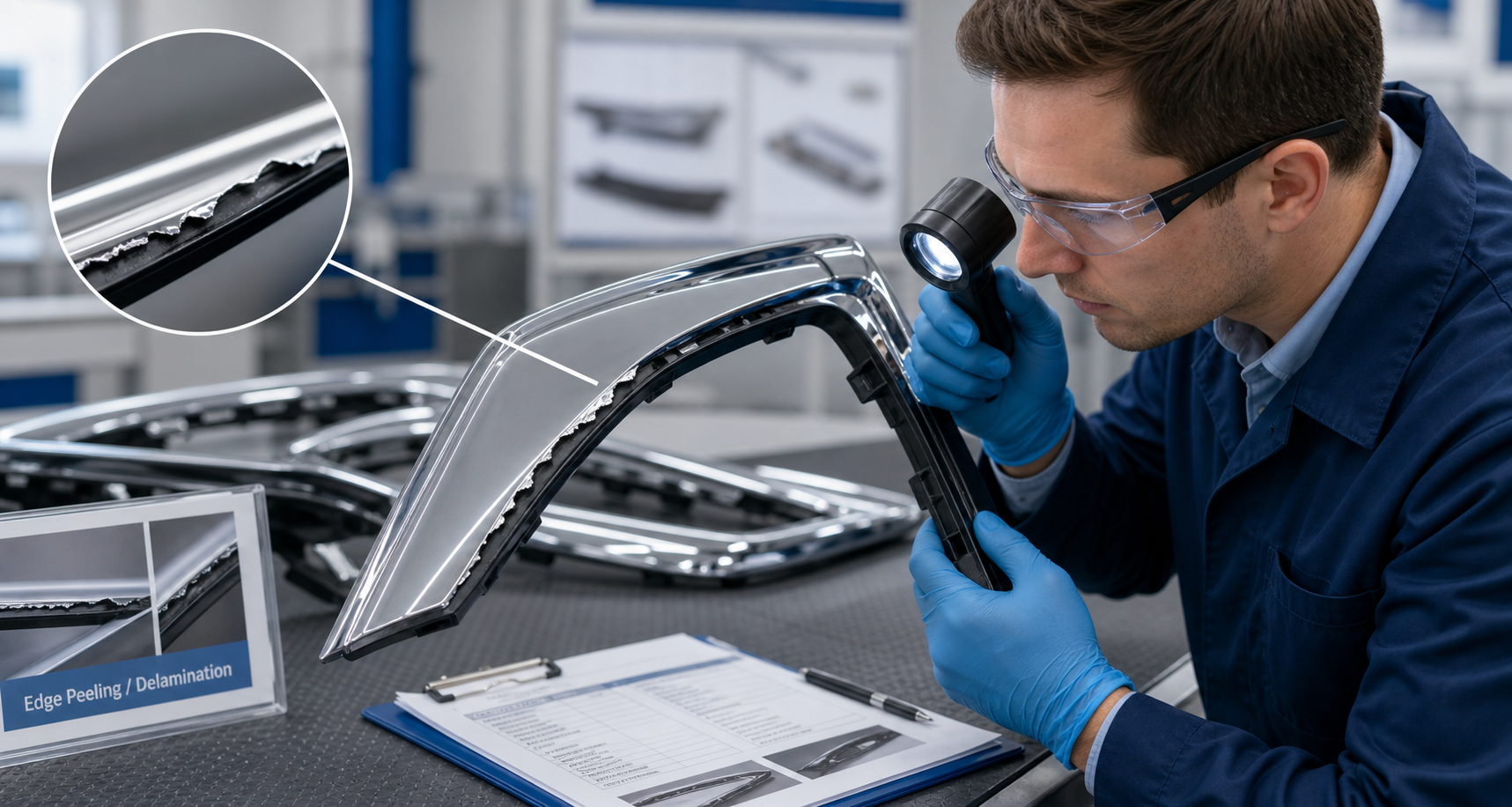
Chrome peeling on plated plastic parts is one of the most frustrating quality problems in decorative electroplating. A part may look perfect when it leaves the plating line, but two weeks later the chrome starts lifting, cracking, or peeling at the edges. In automotive exterior trim and other appearance-critical products, that kind of failure quickly turns into scrap, claims, and supplier disputes.
Many people blame the plating shop first. Others blame the plastic resin. In reality, peeling on plated plastic parts is usually an interface failure problem.
The real issue is not simply temperature difference between plastic and metal. Although plastic and metal have very different thermal expansion behavior, peeling usually happens because the adhesion chain was weakened earlier. In most cases, the root cause is a combination of substrate stress, poor pretreatment, or weak layer-to-layer continuity between nickel and chrome.
Chrome Peeling Is Usually an Interface Failure, Not Just a Plating Defect
For plated ABS parts, good appearance does not always mean good adhesion.
A plated plastic part depends on multiple interfaces staying stable at the same time:
- the plastic substrate itself
- the etched and activated plastic surface
- the electroless and electrolytic buildup layers
- the nickel-to-chrome transition
If any one of these stages is compromised, the final coating may still look smooth and bright at first, but the adhesion reserve drops sharply. Once thermal cycling, humidity exposure, or internal stress begins to act on the system, the coating can fail suddenly.
This is why some chrome-plated plastic parts pass visual inspection but still crack or peel after storage or transport.
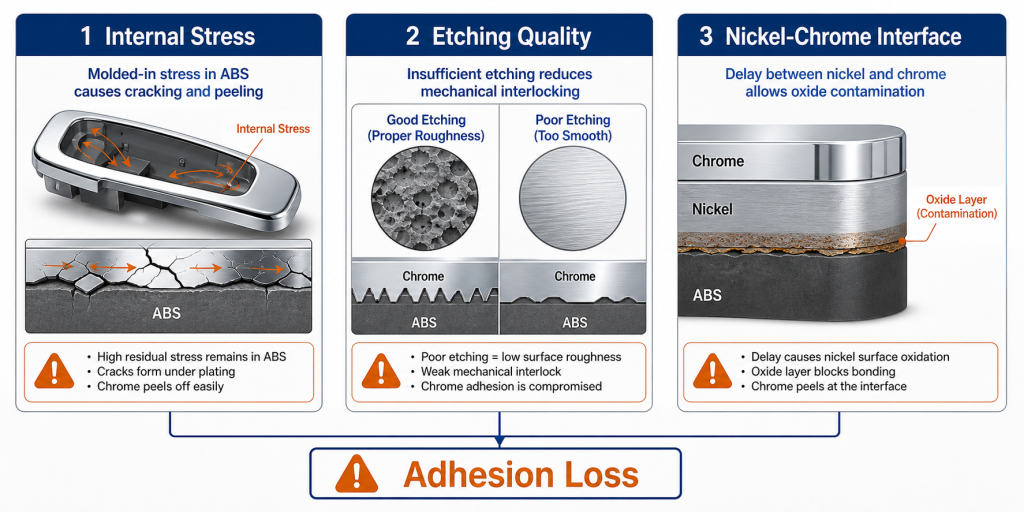
The First Hidden Killer: Internal Stress in the ABS Substrate
ABS remains the classic substrate for decorative plastic plating, but it is also sensitive to molding-induced internal stress.
During injection molding, polymer chains can become stretched and frozen into the part. Stress tends to concentrate in predictable locations:
- near the gate
- around inserts
- at sharp transitions in wall thickness
- in large flat areas with uneven cooling
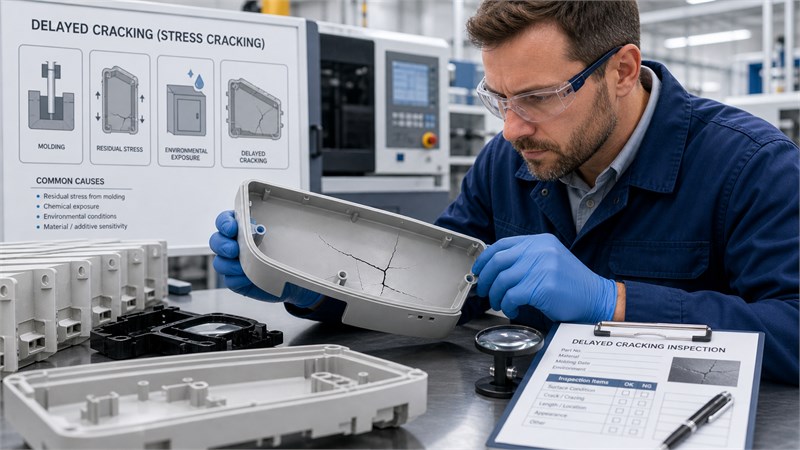
If internal stress remains too high, later chemical exposure during plating pretreatment can trigger environmental stress cracking. The part may show no visible defect before plating, but microcracks can already be forming below the surface. Once plating layers are built on top, those cracks can propagate and eventually appear as peeling, cracking, or edge lifting.
This helps explain a common production mystery: some parts look perfect immediately after plating but begin failing days or weeks later.
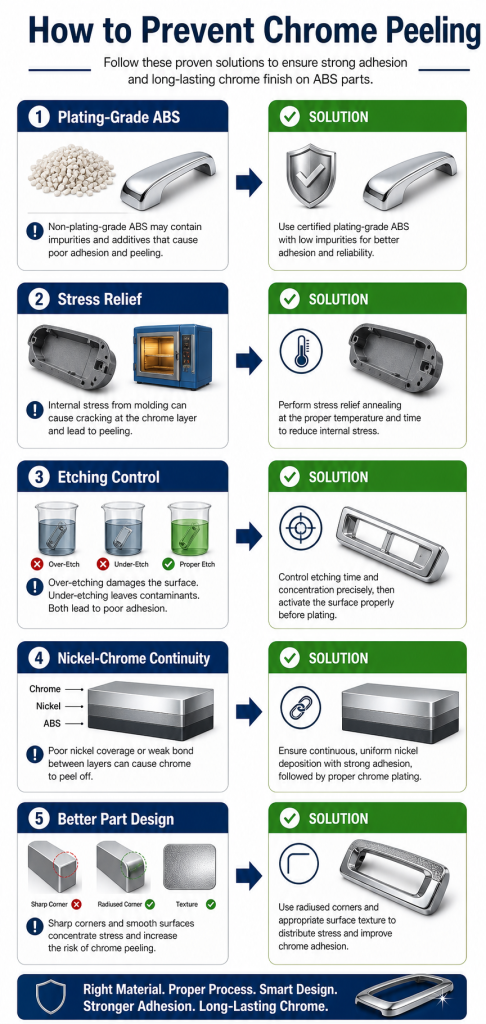
In practice, stress-relief treatment such as controlled annealing can make a major difference when molded ABS parts are intended for plating.
The Second Hidden Killer: Incomplete Etching and Poor Surface Preparation
Pretreatment quality has a huge influence on plated ABS adhesion.
The purpose of etching is not cosmetic. It creates a micro-roughened surface that allows the metal coating to lock mechanically into the plastic. When etching is well controlled, the surface develops enough microstructure for strong physical anchoring. When etching is incomplete or uneven, the coating may still deposit, but adhesion falls dramatically.
Among all pretreatment stages, etching is often one of the most overlooked.
If the etched surface is too smooth, the metal layer has too little anchor profile. If the etch is non-uniform, some areas develop weaker bonding than others. In production, this can lead to localized peeling, especially along edges or stress concentration zones.
A practical shop-floor sign of uneven etching is poor wetting after rinsing. If some areas hold water differently or show bead-like behavior, the pretreatment may not be uniform enough.
The Third Hidden Killer: Weak Nickel-to-Chrome Interface Control
Even when the plastic substrate and pretreatment are acceptable, the coating can still fail if the nickel-to-chrome transition is poorly controlled.
After nickel plating, the nickel surface naturally forms an oxide film when exposed to air. If that surface is left too long before chrome plating, the oxide layer can interfere with interlayer bonding. In practical terms, chrome is no longer bonding to a fresh nickel surface. It is bonding across a degraded interface.
This can reduce adhesion significantly, especially at edges and high-stress areas.
For production control, the rule is straightforward: nickel rinsing, activation, and chrome plating should be managed as a continuous sequence whenever possible. If the line must stop, stored parts should be protected properly and reactivated before the next plating stage.
This is one of the most common reasons a plated part looks acceptable initially but later begins peeling from the outer layer.
Design Also Plays a Bigger Role Than Many Teams Expect
Part design has a strong effect on plating durability.
Large flat plated areas tend to accumulate more interface stress. Sharp corners and 90-degree edges create stress concentration zones. When those design features are combined with molded-in stress and imperfect pretreatment, peeling risk rises further.
Better design practice includes:
- avoiding unnecessarily large uninterrupted plated surfaces
- replacing sharp corners with radiused edges
- adding texture or geometry that helps distribute interface stress
- reducing severe thickness transitions when possible
How to Reduce Chrome Peeling on Plated Plastic Parts
For injection molders, molders with in-house finishing, and plating suppliers, the best results usually come from controlling the problem at three levels.
1. Start with Plating-Grade ABS and Lower Internal Stress
Use ABS grades intended for plating applications. During molding, control orientation and residual stress as much as possible. When needed, use annealing or other stress-relief methods before plating.
2. Tighten Pretreatment Control
Etching, activation, and surface preparation need strict time, temperature, and consistency control. Uneven or weak etching can destroy adhesion even when the final part looks bright.
3. Protect Interface Continuity Between Nickel and Chrome
Do not treat nickel-to-chrome transition time casually. Long exposure before chrome plating can reduce adhesion. Continuous sequencing or reactivation control is critical.
4. Improve Part Design for Plating Reliability
Avoid high-stress geometry where possible. Large flat areas, sharp corners, and abrupt section changes all increase peeling risk.
5. Treat Peeling as a System Problem
A peeling failure should not be assigned automatically to either the molding side or the plating side. The correct approach is to review the full chain: molding stress, substrate grade, pretreatment consistency, layer sequencing, and part design.
Why This Matters More Today
This issue is becoming more important as manufacturers push harder for stable cosmetic quality, longer warranty performance, and tighter process consistency across global supply chains. At the same time, Plastics Europe’s recent market reporting continues to show how important plastics remain in transport and technical applications, while process quality and durability expectations keep rising across industrial products. For plated automotive trim and other appearance parts, that means adhesion reliability is not optional. It is a core quality requirement.
Conclusion
Chrome peeling on plated plastic parts is rarely just a chrome problem. It is usually an interface failure caused by one or more hidden weaknesses in the system.
The three most important hidden killers are high internal stress in the ABS substrate, incomplete or uneven pretreatment, and poor nickel-to-chrome interface control. When these problems combine, a part can look perfect after plating and still fail later.
For manufacturers, the real solution is not only better plating chemistry. It is better control of molding stress, pretreatment discipline, interlayer timing, and product design from the start.
FAQ
Why does chrome peel off plastic parts after plating?
Because the adhesion chain has already weakened somewhere in the system. The most common causes are stressed ABS substrate, poor pretreatment, or weak bonding between plating layers.
Is chrome peeling mainly caused by the plating factory?
Not always. Many failures begin in the plastic substrate or molding stage, especially when internal stress is too high before plating starts.
Why is ABS commonly used for plated plastic parts?
ABS is widely used because it can be etched and activated effectively for decorative plating, especially in automotive and consumer appearance parts.
Why is etching so important in plastic plating?
Etching creates the micro-roughened surface needed for mechanical interlocking between the plastic and the metal coating. If etching is incomplete, adhesion can fall sharply.
Can nickel-to-chrome timing affect adhesion?
Yes. If the nickel surface sits too long before chrome plating, oxide formation can weaken the interface and increase peeling risk.
How can manufacturers reduce peeling on chrome-plated plastic parts?
They can use plating-grade ABS, reduce molded-in stress, control pretreatment more tightly, maintain proper nickel-to-chrome sequencing, and avoid high-stress part geometry.